


Let AI summarize this article for you
Fresh categories — dairy, yogurt, bakery, meat, fruits and vegetables, ready-to-eat meals, and ultra-fresh products — combine high turnover and strong margins with the largest share of operational losses in grocery retail. These losses stem from three interconnected constraints: short shelf life, high demand volatility, and frequent product write-offs.
Retano SCM is a supply chain management platform built specifically to address the replenishment complexity of fresh and perishable categories, helping retailers maintain high on-shelf availability while reducing expired product waste and working capital locked in excess inventory.

Why Fresh Category Replenishment is operationally complex
Fresh category replenishment operates under a set of constraints that are tighter and more interdependent than those found in dry goods or non-perishable segments.
The core constraints are:
- Short and variable shelf life — most fresh SKUs have a 3–14 day window, leaving minimal margin for forecasting error or logistics delays
- High demand volatility — consumption patterns shift significantly between weekdays and weekends, during holidays, in response to weather, and under promotional activity
- Logistics constraints — fixed delivery schedules, minimum order quantities (MOQ), pack-size rounding rules, and supplier-specific restrictions introduce systematic overstock risk independent of demand forecasting accuracy
- Data distortion — out-of-stock periods, promotions, and anomalous events corrupt raw sales data, making historical records an unreliable foundation for replenishment decisions
In addition to these product-driven constraints, many grocery retailers operate in-store production facilities — bakeries, deli counters, salad stations, and ready-to-eat preparation areas — which introduce a separate planning layer: ingredient-level replenishment that must be synchronized with finished goods forecasting.
How Automated Replenishment works in Fresh Retail
Effective replenishment for fresh categories requires integrating demand forecasting, shelf-life tracking, logistics constraint management, and operational execution into a single continuous process. Retano SCM structures this as six interconnected capabilities.
1. Demand Signal Correction
Accurate replenishment begins with reconstructing true consumer demand from distorted sales data. In fresh categories, raw point-of-sale records systematically underrepresent real demand. When a product is out of stock, sales register as zero even though customer demand continues. Promotional periods create spikes that, if not isolated, inflate future forecasts. Seasonal anomalies and one-time events introduce noise that skews baseline models.
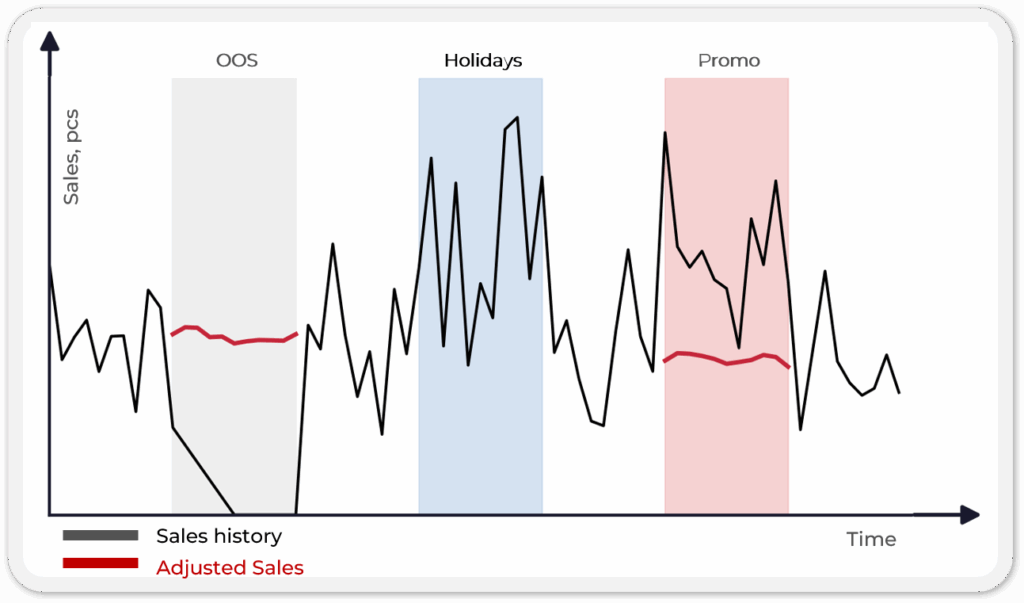
Retano SCM’s demand signal correction engine filters out these operational distortions, adjusting for OOS periods, promotional uplift, and anomalous spikes. The result is a clean demand baseline for each SKU at each store location — one that reflects actual consumption patterns rather than the artifacts of operational interruptions.
2. Multi-Level Forecasting and Adaptive Replenishment
Fresh demand is highly unpredictable, shifting rapidly based on the product, the specific store location, and active promotions. A basic, one-size-fits-all forecasting model simply cannot keep up with all these moving parts at once.
Retano SCM approaches this differently by analyzing demand from multiple angles simultaneously. The platform looks at the big picture — like broad seasonality and holidays — while at the same time pinpointing specific trends for individual products at each store. It also accounts for promotional spikes and how a discount on one item naturally impacts the sales of nearby products on the shelf.
Once the system builds this comprehensive demand picture, it switches to adaptive replenishment. Forget rigid, static ordering rules. Retano SCM constantly updates safety stock and order sizes in real time based on what is actually happening right now—taking into account current stock, delivery times, and remaining shelf life to keep shelves full without creating waste.
3. Shelf-Life Intelligence with Virtual Batch Modeling
A common source of avoidable write-offs in fresh retail is invisible expiration risk: aggregate inventory appears sufficient, but a portion is already too close to expiration to sell before spoiling.
Retano SCM addresses this through virtual batch modeling — a continuous segmentation of on-hand inventory by delivery batch and remaining shelf life. The system simulates how existing inventory will move through the store over time and projects which units carry spoilage risk before the next replenishment cycle.
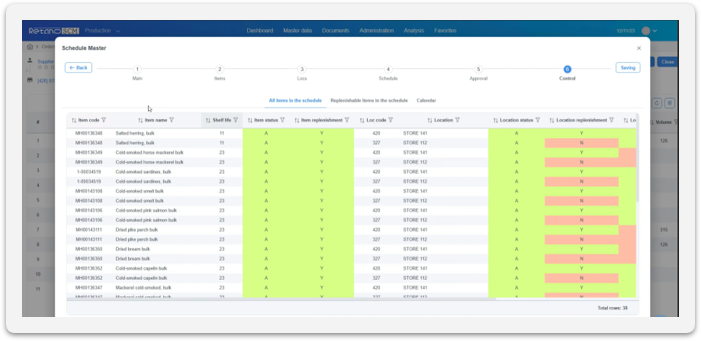
When calculating new order quantities, the system excludes inventory projected to expire before it can be sold. This prevents new deliveries from compounding existing at-risk stock, directly reducing avoidable write-offs.
4. Logistics-Aware Replenishment
Fresh replenishment can fail at the logistics layer independently of forecasting quality. A supplier’s minimum order quantity may require ordering significantly more than demand justifies. A holiday delivery gap may leave shelves without replenishment for several days. A pack-size rounding rule may add units that expire before the next sales cycle.
Retano SCM integrates logistics constraints directly into replenishment calculations:
- Permanent and temporary delivery calendars — replenishment windows adjust automatically for weekends, holidays, store closures, and seasonal supply changes
- Pack-size and MOQ compliance — order quantities are calculated within supplier-defined constraints
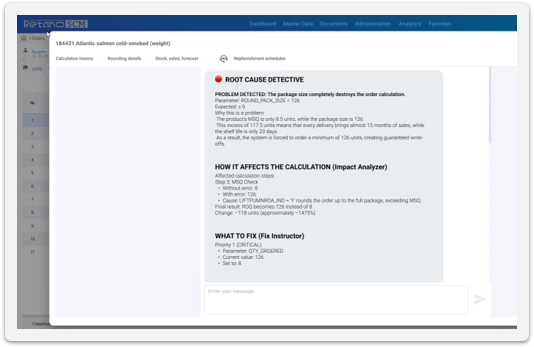
- Proactive mismatch detection — when forecast demand is low but supplier constraints require a large minimum order, the system flags the elevated waste risk before the order is placed
This allows planners to adjust ordering strategy ahead of time rather than responding to inventory problems after they occur.
5. In-Store Production and BOM-Based Replenishment
Retailers operating in-store production facilities — bakeries, delis, prepared food stations, salad counters — require a replenishment model that extends from finished products back through the ingredient chain.
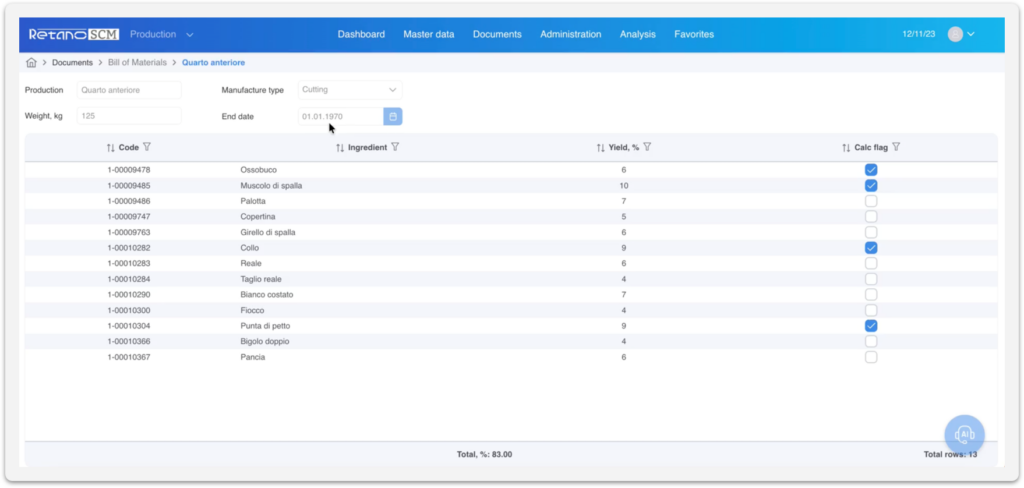
Retano SCM integrates Bills of Materials (BOM) directly into the replenishment engine. Forecasted demand for finished products is automatically decomposed into ingredient-level requirements — flour, eggs, produce, packaging — and planned accordingly across the supply chain.
The platform supports multiple replenishment cycles per day, enabling efficient operation of ultra-fresh, multi-wave production environments where ingredient needs vary throughout the day.
6. AI-Powered Exception Management
Managing thousands of daily replenishment decisions manually is not operationally viable at scale. Retano SCM automates routine ordering decisions and surfaces only the situations that require planner judgment.
The built-in AI assistant explains replenishment recommendations in natural language, identifies elevated risk situations — potential write-offs, projected stockouts, supplier constraint conflicts — and provides options for planners to review. Planners work exception-by-exception, focusing their attention on high-risk decisions while the system handles standard ordering automatically.
Operational Outcomes
Retailers deploying Retano SCM for fresh category replenishment report outcomes across four dimensions:
- Write-off reduction — virtual batch modeling and logistics constraint detection reduce expired product losses by preventing over-ordering on at-risk inventory
- On-shelf availability improvement — adaptive forecasting and dynamic safety stock maintain availability during demand volatility, supporting sales continuity
- Working capital optimization — more precise order quantities reduce excess inventory without compromising service levels
- Planning efficiency — exception-based automation reduces the daily manual workload of replenishment operations
Fresh category replenishment is among the most operationally demanding functions in grocery retail. Short shelf life, volatile demand, logistics constraints, and in-store production dependencies converge into a planning environment where errors in either direction — overstock or stockout — carry immediate financial consequences.
Retano SCM is a supply chain management platform built specifically for this environment. By combining demand signal correction, multi-level forecasting, logistics-aware replenishment, BOM-based production planning, and AI exception management, the platform enables grocery retailers to manage fresh category replenishment at scale — reducing waste, improving availability, and lowering the operational cost of daily ordering.