


Retano CatMan
Category management solution for retail
Assortment Planning and Category Strategy Powered by Big Data & AI
Let AI summarize this article for you

Profitable retail runs on disciplined, data-driven category management
Retano CatMan is a category management system that converts Big Data and AI-driven analysis into structured assortment decisions. It supports store clustering, assortment rationalization, demand forecasting, and category strategy planning — translating operational data into actions that improve turnover, margins, and customer retention.
Retano CatMan is designed for grocery, FMCG, DIY, drogerie, and pharmacy retailers operating hundreds of stores, where manual category analysis no longer scales.
What Retano CatMan solves for retail category managers
 Assortment Optimization
Retano CatMan analyses sales history and demand patterns at the store cluster level to identify structural gaps and imbalances in the assortment. This enables retailers to maintain optimal SKU depth and shelf availability without manual category reviews.
 Increased Profitability
The solution evaluates each SKU’s contribution to category sales, margin, and turnover within its cluster. Structured assortment decisions based on this analysis reduce slow movers and inventory write-offs while improving category profitability.
 Enhanced Customer Experience
Structured assortment planning ensures a balanced mix of price tiers, key product attributes, and relevant SKUs within each store cluster. This consistency reduces shelf complexity and makes product selection more predictable for shoppers across the chain.
 Business Flexibility and Adaptability
Retano CatMan monitors category performance analytics continuously, enabling category managers to detect deviations from planned assortment structure and apply targeted corrections by cluster without disrupting the entire chain.
 Waste Reduction
By highlighting low-rotation items and structural overrepresentation within categories, Retano CatMan supports assortment decisions that reduce excess stock and minimise losses from slow-moving or near-expiry products over time.
Data-driven category management: The key to stable profitability growth and increased customer loyalty.
Core capabilities for assortment planning
Store Clustering for Data-Driven Category Management
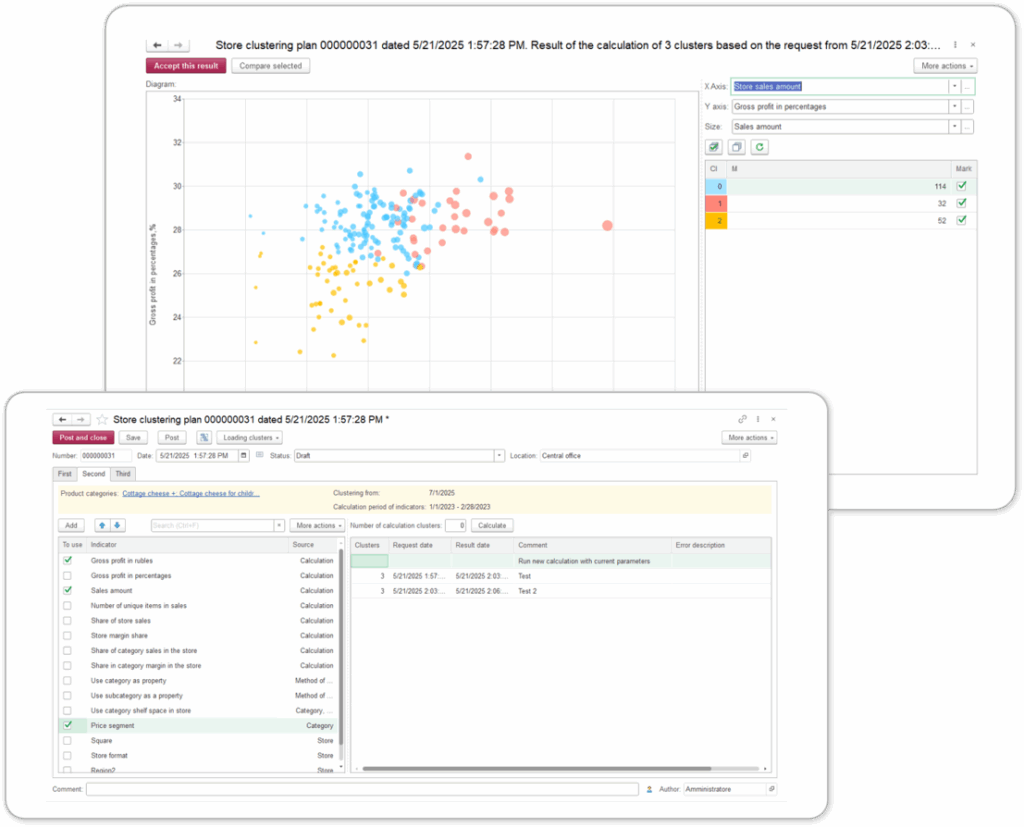
- Store clustering based on actual consumer demand patterns within each category, independently of store format, size, or region.
- Cluster configuration applied at the category level, producing store groups that are commercially meaningful for assortment decisions.
- ML-driven demand analysis to capture differences in demand structure across the stores.
- Seamless with Retano Shelfplan to factor shelf capacity constraints into cluster configuration from the start of the planning cycle.
Assortment Rationalization and Planning
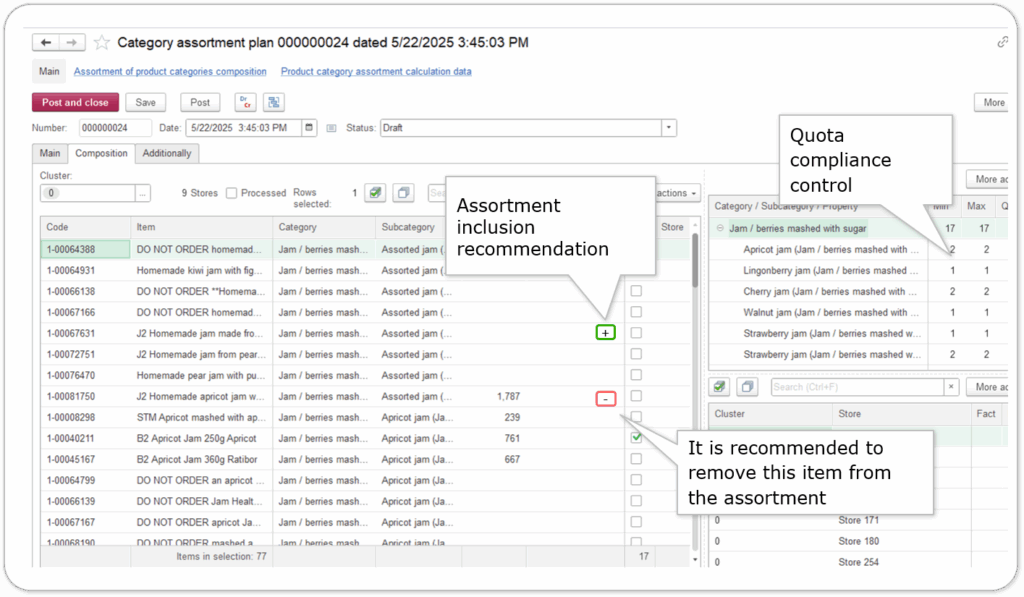
- Evaluation of SKU contribution across sales, margin, and category structure for each store cluster — identifying items that support the category’s role and those that create redundancy or structural imbalance.
- ML-powered recommendations on SKU inclusion and exclusion within each cluster, based on category goals and demand signals.
- Target assortment built per cluster against defined category constraints and forward-looking demand signals.
Category Strategy, Role Definition, and Performance Analysis
- Assignment of category and subcategory roles and strategies at both chain and cluster level, with configurable properties across a structured product classification hierarchy.
- ML-based analysis of actual vs. planned category role — surfacing gaps between intended strategy and real commercial behaviour.
- Detection of structural deviations from planned assortment, providing category managers with a consistent basis for periodic reviews.
- Analytical reporting on category and SKU performance across key commercial metrics: sales, margin, and turnover.
See how Retano CatMan supports assortment planning and category strategy across your stores
FAQ
Publications
Category management software for retail chains: a 2026 buyer’s guide
The full process — from category role to measuring the effect of a change For a retailer with ten stores, assortment management is an analysis problem: one person looks at the numbers and decides. For a chain of 80, 200 or 500 stores it becomes an operational discipline that touches commercial strategy, supplier negotiation, replenishment… Read More »Category management software for retail chains: a 2026 buyer’s guide
Retano at NRF Retail’s Big Show Europe 2026
Retano Solutions took part in NRF Retail’s Big Show Europe, held on 15–17 September 2026 at Paris Expo Porte de Versailles, presenting its AI-driven retail platform at Stand C-070 in Hall 6. NRF Retail’s Big Show Europe is the European edition of the retail industry’s flagship event, co-organised by the National Retail Federation and Comexposium.… Read More »Retano at NRF Retail’s Big Show Europe 2026
How do you spot a customer who is about to stop buying?
Churn prediction reads the change in each customer’s own purchase behaviour — visits spacing out, basket falling — and flags the risk while it is still forming. What the model needs, how Retano CRM & Loyalty prioritises the at-risk list by customer value, and what to send the people on it. In short Why doesn’t… Read More »How do you spot a customer who is about to stop buying?