


Let AI summarize this article for you

How does AI-powered planogram software improve shelf performance as assortment and demand change?
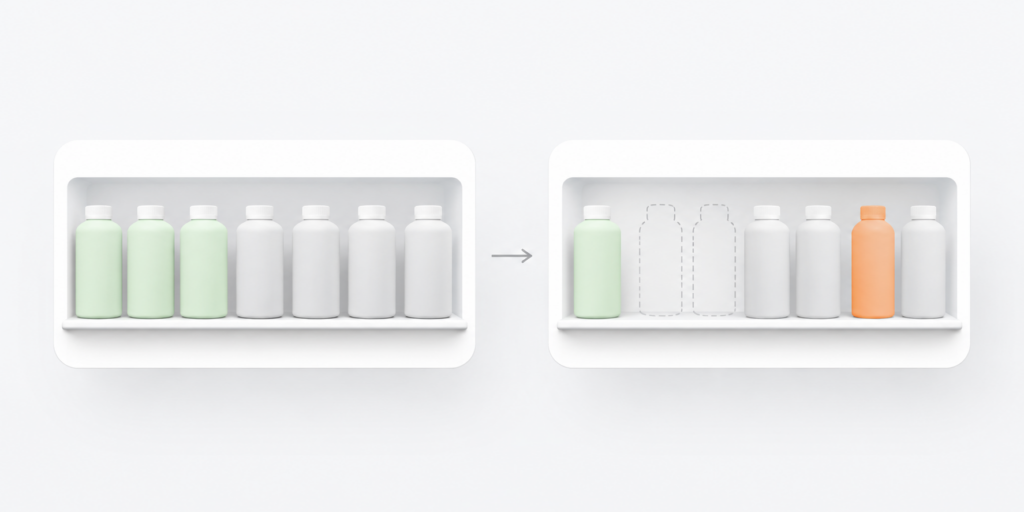
The gain comes from how often a layout can be corrected, not from any single planogram: AI-powered planogram software recalculates space allocation as sales, assortment and equipment change, which is what keeps shelf performance from decaying between category resets. Retano Shelfplan derives each layout from fixture geometry, product master data (dimensions, packaging, placement constraints) and sales performance ranked by turnover, units or profit. Facings are then sized so that the share of shelf area a product holds corresponds to its weight in the selected criterion, within the limits set for each ABC class.
What separates automated generation from rule-assisted drawing in grocery retail and FMCG is the scale of recalculation. Layouts can be rebuilt in bulk — a single store, a format, or the entire chain — and the result comes back as a change summary plus a list of items the algorithm could not place, so a category manager works through exceptions instead of redrawing shelves.
Shelf performance is then measured on the same data the layout was built from: revenue per unit of occupied and usable shelf area, sales results visualised directly on the fixture layout, and heat-zone analysis of the sales floor. Where analytical services are connected, layout recommendations arrive as concrete facing changes that can be compared against the current version before being applied.
Which retail planogram and space planning software features should be verified on a chain’s own data?
The features worth verifying against real store data are the ones that determine how much manual work remains after go-live. Two are routinely underestimated during evaluation: the master data the system needs before it can generate anything at all, and how much of a chain’s actual equipment it can represent.
- Master data readiness — how the system behaves when dimensions or packaging attributes are missing for part of the assortment, and how those gaps are closed before the first layout is generated. Retano Shelfplan keeps physical dimensions in a dedicated database with bulk import and export, and implementation includes normalising what already exists in the retailer’s systems.
- Non-standard fixtures without one-off work — hooks and perforation zones, baskets, vertical zones and equipment with no standard shelf layout, handled through reusable equipment templates rather than a separate configuration per store.
- Exception handling — a readable list of items the algorithm could not place, and a way to resolve them without rebuilding the layout from scratch.
- Recalculation at chain scale, so a category reset does not become a multi-week manual project.
- Execution link to stores — layout tasks in the mobile app, photo confirmation, realogram capture, and automated compliance verification through Retano VeriShelf AI.
- Data exchange with adjacent planning — Retano Shelfplan works with Retano Catman and passes shelf capacity into Retano SCM.
Version history, planogram comparison and electronic approval are baseline in this software category rather than differentiators.
What can AI tools that detect out-of-stocks with shelf scanning and computer vision actually see?
These tools compare a shelf image against the approved planogram and sort the discrepancies by type: an item absent, fewer facings than planned, a product in the wrong position, a foreign product on the shelf, a layout that has drifted from the standard. A missing product is only one of those types. Retano VeriShelf AI applies a recognition model pre-trained on retail imagery and adapted to a specific chain’s assortment — deviations are registered without a supervisor present, a corrective task reaches the store associate almost immediately, and the verification result returns to Retano Shelfplan, where the planogram it was checked against is maintained.
Of all the discrepancy types, it is the empty space that needs careful reading, particularly in grocery retail and FMCG. Computer vision reports the state of the shelf at the moment of capture, not the state of inventory: a gap may mean the item is sold out chain-wide, sitting in the backroom, or displaced to another fixture. Separating those cases requires stock and replenishment data alongside the image. Misplacement carries no such caveat — the discrepancy against the planogram is visible in the image itself.
Two operational conditions set the practical ceiling. Consistent image capture matters more than it appears: lighting, angle and framing were where early shelf-recognition deployments lost precision, and that discipline sits with store teams rather than with the model. Capture frequency sets the rest: a fixture photographed weekly yields a weekly picture of on-shelf availability, however accurate each reading is.
What causes out of stocks on the shelf in grocery stores, and how do retailers address them with software?
Out-of-stocks in grocery retail trace back to four distinct causes, and identifying which dominates a category matters more than the choice of tool. All four are measured at the same point — the shelf — but differ in whether the product is also missing from the store or only from the facing, and that decides which system helps. Industry estimates commonly put the share of SKUs missing from the shelf at roughly 5–10% at any moment, rising during promotions; figures vary by category, format and measurement method, so they indicate scale rather than a target to plan against.
Demand forecasting errors produce genuine shortages with no stock anywhere in the store. Shelf capacity out of step with delivery frequency empties the facing between deliveries on fast-moving items, while stock remains available elsewhere in the chain. Execution failures leave the product in the store but off the shelf: in the backroom, on the wrong fixture, or unreplenished after a promotional reset. Inventory record inaccuracy masks the other three, because the system shows stock the shelf does not have.
No single tool closes all four: the causes sit in different processes, so the systems differ. Retano SCM works on the ordering side. Retano Shelfplan works on capacity: shelf capacity from the planogram feeds supply chain planning, so facing counts and delivery frequency are set against each other rather than independently. Retano VeriShelf AI works on execution. Record accuracy is the one cause software surfaces rather than resolves: it needs counting discipline in the store.