


Let AI summarize this article for you
How does a recommendation model choose which products to put in one shopper’s personal offer?
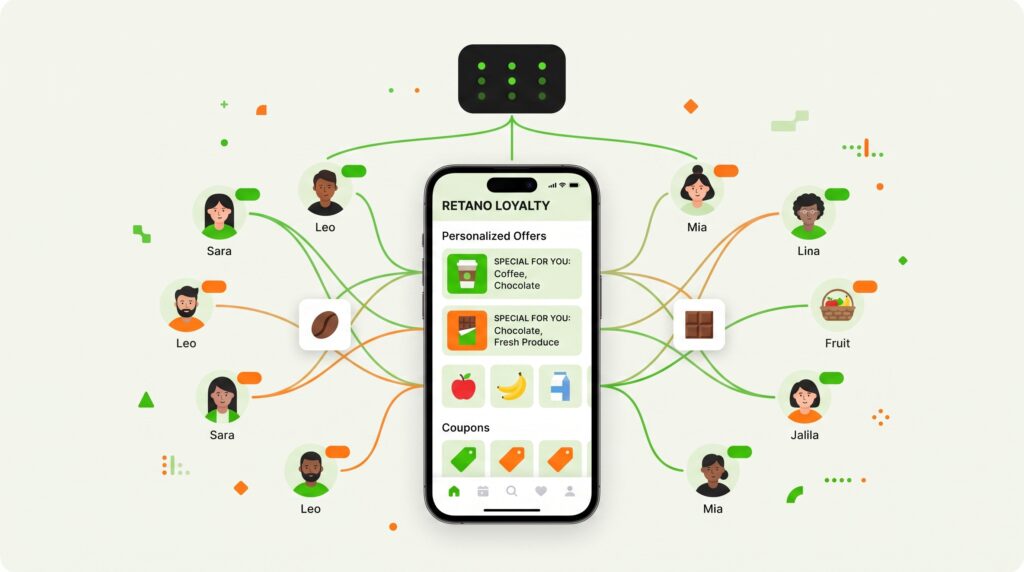
The model works from similarity of behaviour rather than from customer attributes: it finds the shoppers whose baskets resemble this one, and ranks every product by how likely this particular customer is to buy it. The input is transaction data — what people actually bought, and in what combination.
In Retano CRM & Loyalty the resulting list is built per customer rather than per segment, so the offer is unique to the individual instead of shared across a group. The list is generated for a specified target date. Once calculated, the list feeds a reward mechanic in the loyalty program and is displayed in the mobile app, where the customer already keeps their loyalty card and active coupons, so the offer is met while planning a trip rather than after the trip is over.
The commercial target is basket economics rather than open rate. The stated aims of the mechanic are cross-sales, more items per receipt, and a shorter interval between visits. Reported results from deployed programs put average basket size among loyal customers 63% higher and average transaction value 21% higher.
What stops a personalized offer from recommending something irrelevant?
Filtering, applied after the model has ranked candidates and before anything reaches the customer. This is the step that separates a recommendation engine that works in a supermarket from one that works in a demo.
Retano CRM & Loyalty applies several constraints, four of which matter commercially. Categories that should never carry a personal offer are excluded outright — carrier bags, cigarettes, the loyalty card itself — because a personal recommendation for a carrier bag damages the credibility of every other offer in the program. Slow-moving items are excluded, so personalization is not quietly repurposed as a way to move stock nobody wants. Products the shopper bought very recently are dropped, since discounting a repeat purchase gives away margin on a sale that was already going to happen. And the list is restricted to products with recent sales in the store where that customer shops most often, so the recommendation reflects the assortment that store actually trades rather than the chain’s full catalogue.
The last constraint is the one that is easiest to skip and most visible when it is missing. A chain-wide recommendation list will happily suggest items a particular store has never carried, and the customer reads that as the retailer not knowing its own network.
How do you personalize for a shopper who has no purchase history?
On a separate path from active customers, which is the part most personalization programs skip. New members and lapsed shoppers are where the growth headroom sits, and they are precisely the customers a similarity model has least to work with.
Retano CRM & Loyalty handles them in two ways. A customer who made no purchases during the model’s training period receives recommendations built from their earlier purchase history, however thin, and where even that is not sufficient the list is completed with popular products. For customers who are in the training set but end up with too few candidates after filtering, the gap is filled from the products selling best in the store that customer actually uses, measured on recent receipts from that specific store rather than a chain-wide bestseller list — because the top sellers of a city-centre convenience format and a suburban supermarket are different products.
Segmentation supports the same group from the other side: customers who have just registered with little history, customers who bought once and never returned, and customers who used to buy and have been absent for a long time are each identified as a distinct segment and can be given their own mechanic. The honest limit is that a first offer to a customer with no history is an informed guess, not a prediction — its role is to generate the second receipt, which is what the model actually needs.
How do product associations change the way a promotion is designed?
They replace assumption with evidence about which products carry each other. Analysis of individual receipts across a chain reveals pairwise dependencies between products — in plain terms, who bought X also bought Y — and Retano’s AI analytics turns those into four inputs for the promo calendar.
Complementary products are selected so a reward mechanic holds together commercially instead of discounting items chosen by intuition. Driver products are identified — items whose sale pulls other items with it, which can be worth promoting even on thin margin because the return arrives elsewhere in the basket. Combinations are analysed within specific customer segments, since the pairs that work for full-price regulars are not the pairs that work for promo-driven shoppers. And the stability and seasonality of each connection is tracked over time, so a mechanic is not built on a pattern that held for a single quarter.
The output is concrete enough to configure directly: 20% off one item from the coffee category when three items from the chocolate category are purchased.
Which shoppers should receive a discount, and at what depth?
The ones whose behaviour changes because of it. A blanket discount is also paid to the customers who would have bought at full price anyway, and behavioural analysis is what makes that group visible.
Retano’s AI analytics separates the base into groups with distinct commercial profiles:
- a core that buys frequently, in large volumes, at full price;
- a loyal group with frequent purchases, a good average bill and low promo dependency;
- a stable regular group with a predictable average bill;
- customers who visit irregularly with no settled loyalty;
- customers who buy almost exclusively during promotions with a low average bill;
- and customers whose activity has faded to the edge of churn.
Each group can carry a different mechanic at a different depth, which is a different exercise from sending everyone the same coupon and measuring the response.
Churn scoring follows the same principle by crossing risk with customer value, so win-back spend concentrates on high-value customers genuinely at risk rather than on everyone who missed a week. Reported retention improvement across deployed programs is 50%, and the platform is positioned to hold loyalty costs flat as personalization is added. The caveat is that discount depth is a commercial decision, not a model output — the analytics identifies who, and the retailer decides how much.
Want personal offers built on your own transaction data?
Retano CRM & Loyalty runs the models, the reward mechanics and the communications on one platform. Book a demo and we will show personal product offers, product associations and behavioural segmentation on retail data.