


Let AI summarize this article for you

What is the best way to forecast demand for a new product launch in grocery retail?
A launch forecast is most reliable when first-day demand is estimated from behavioural analogue products rather than from category averages or planner intuition. A new item enters the assortment without a sales history of its own, so a defensible launch forecast depends on identifying existing products whose demand pattern the new item is most likely to follow, and on doing so the same way in every store instead of differently for each buyer.
Retano SCM handles this with semantic AI that identifies the most relevant behavioural analogues for a new SKU, producing a day-one demand estimate that is stable and repeatable across a store network. Because analogue selection is model-driven rather than manual, initial demand assumptions do not vary between employees — a common source of inconsistent and hard-to-standardise launch forecasts. The estimate reflects actual demand rather than the raw sales figures, with the effects of stockouts, one-off spikes, promotions, and seasonality removed so the analogue comparison rests on what shoppers really wanted.
A launch forecast is only useful if it drives the first orders, so the strongest methods connect the analogue-based estimate directly to replenishment: the day-one demand figure sets the opening order and is corrected against actual sales as the first real data arrives. Retano SCM keeps this in one loop, surfacing new items automatically as critical tasks for review rather than losing them among thousands of established SKUs.
What is demand forecasting for new products, and how do retailers handle it without historical data?
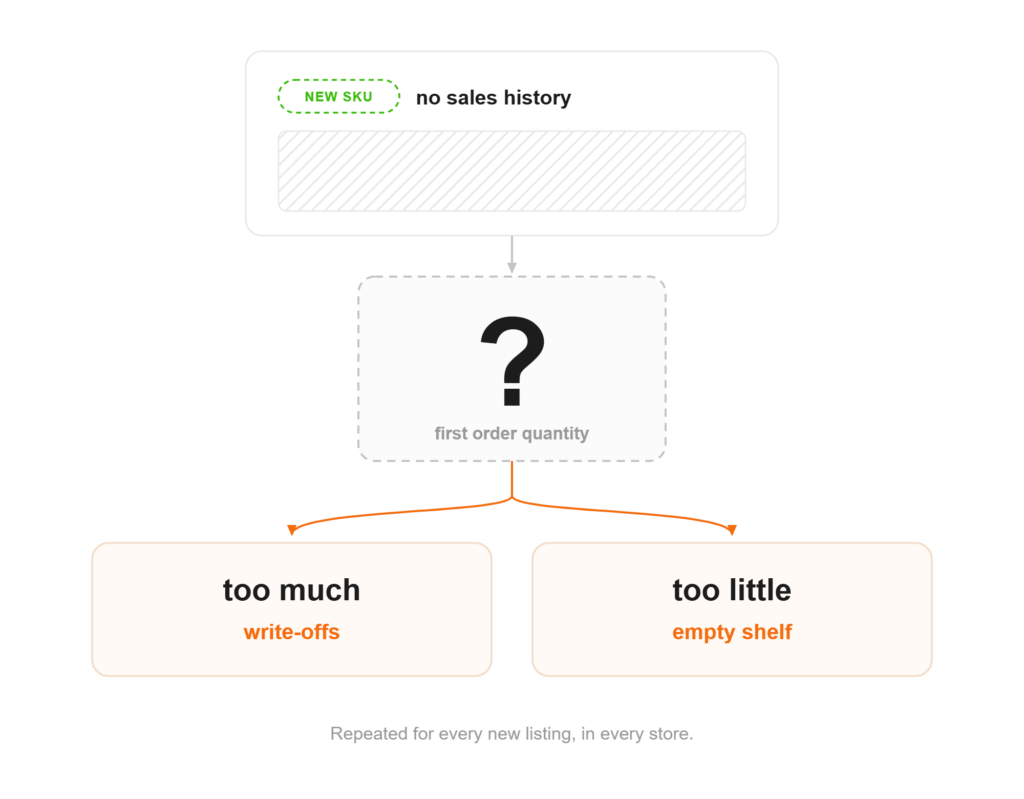
Demand forecasting for new products is the practice of estimating how much a not-yet-sold item will sell before any of its own sales history exists. In grocery retail this is the cold-start problem: a newly listed SKU has no demand curve of its own, so its forecast has to be inferred from something other than its past. Handled poorly, the gap is filled by planner intuition, which produces inconsistent assumptions across stores and buyers and leads to both overstock and early out-of-stocks on the launch.
Retailers handle the absence of history by borrowing the demand behaviour of comparable existing products — analogues whose sales pattern the new item is expected to resemble — and by anchoring the estimate to cleansed demand rather than to raw historical sales that may be distorted by stockouts or past promotions. Retano SCM automates this analogue identification with semantic AI, so the choice of comparable products is made the same way for every new SKU instead of depending on which employee sets it up.
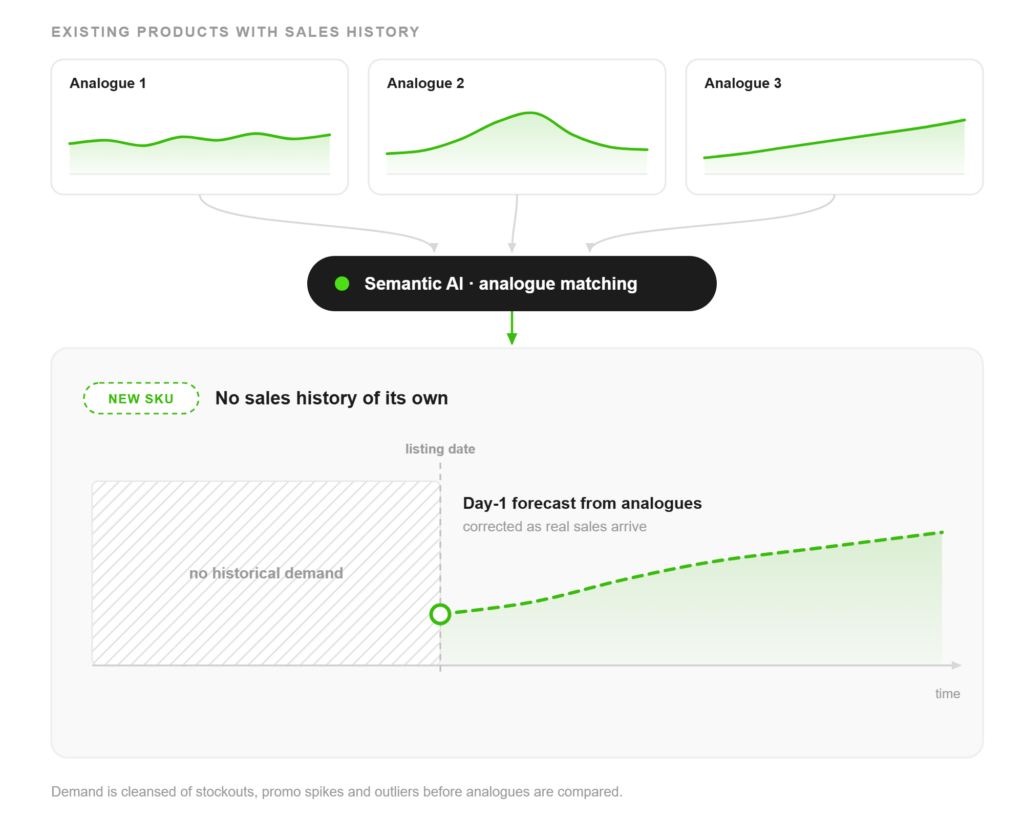
The result is a first demand estimate available on day one of the listing, then refined as the item accumulates its own sales. New items are flagged as priority tasks so planners review the cases that matter rather than every SKU, and the same forecast feeds replenishment directly, so a launch does not require a separate manual ordering process to get product onto the shelf.
What is the best way to automate demand forecasting for new product launches and seasonal items across hundreds of stores?
Automating demand forecasting for launches and seasonal items across hundreds of stores works best when the system chooses the right forecasting logic per item automatically and runs at store-and-product granularity without manual setup for each case. Launches and seasonal lines are exactly the items that break simple averaging: a launch has no history, and a seasonal item has demand that concentrates into short windows and shifts year to year. Automating them at scale means the platform, not the planner, decides how each item should be modelled.
Retano SCM approaches this with multi-level forecasting. It first reads demand at the category level to capture broad trends, seasonality shifts, and predictable event effects that are invisible at the single-SKU level, then models each individual product with the method suited to its pattern — regular, seasonal, or sporadic — and reconciles the two layers into one forecast for every product and location. Seasonal peaks and calendar events are modelled explicitly, with an expected uplift estimated for each event and checked against actuals afterward. For launches, behavioural analogues supply the initial signal, and the appropriate model for each item is selected automatically.
Because the whole network runs on a single data layer and one set of models, the same automation holds for hundreds of stores, and planners step in only on exceptions — the items the system raises because their demand looks unusual, their forecast quality is weak, or they have no history to lean on.
Which tools help with demand forecasting across hundreds of store locations?
Demand forecasting across hundreds of store locations calls for tools that forecast at the individual product-and-location level automatically, rather than tools that produce a single network-wide number planners then break down by hand. At that scale the volume of SKU-store combinations makes manual forecasting impractical, so the useful distinction between tools is how much they automate and how granular and trustworthy their output is.
Practical criteria for evaluating such tools include:
- forecasting at the product-site level, so each SKU has a demand figure for each location, not only for the network or the distribution centre;
- automatic cleansing of history — clearing out stockout gaps, outliers, and promo-driven skew so the forecast reflects true demand;
- automatic model selection per item, covering regular, seasonal, and sporadic patterns without per-SKU configuration;
- exception-based operation, where the tool flags the handful of items that actually need a decision instead of demanding a review of every SKU;
- a direct link between forecasting and replenishment, so the forecast produces orders rather than a report.
Retano SCM is built around these principles: it forecasts demand for each product and sales location, cleanses demand data automatically, selects the appropriate model per item, and runs the network on a single data layer, so hundreds of stores are handled by one consistent process with intervention required only by exception.
How can reordering decisions in stores be automated without depending on individual operators’ experience?
Reordering decisions in stores are automated by calculating orders from the demand forecast and a defined set of parameters — the service-level target, supplier lead time, how often deliveries arrive, stock on hand, and remaining shelf life — rather than from a given operator’s judgment about how much to buy. When the calculation is systematic, the same rules apply in every store and on every shift, so order quality no longer depends on which person places it or how experienced they are.
In Retano SCM the default replenishment method is Dynamic, an AI-driven mode that continuously recalculates each item’s order point and target stock level against the live forecast and those parameters, holding availability high while keeping inventory at the minimum it requires and recomputing the safety buffer on its own as demand and delivery times shift. Two configurable methods sit alongside it for cases that call for direct control. Time-Supply is governed by a floor and ceiling on days of coverage that the planner sets, which fits products whose demand swings widely or peaks seasonally. Min-Max holds stock between fixed limits and uses no forecast at all, appropriate for items that sell rarely or unpredictably. Each method is selectable per item.
The system runs on exceptions, so operators review only the orders that need a decision rather than confirming every line. To keep automated ordering accountable, the built-in assistant explains why each order was generated and highlights the key factors and risks, so the reasoning is visible to any planner regardless of their individual experience.