


Retano Shelfplan Planogram software for retail space planning
Automatic planograms from sales data and merchandising rules, bulk updates and compliance tracking.
Ask AI about Retano Shelfplan
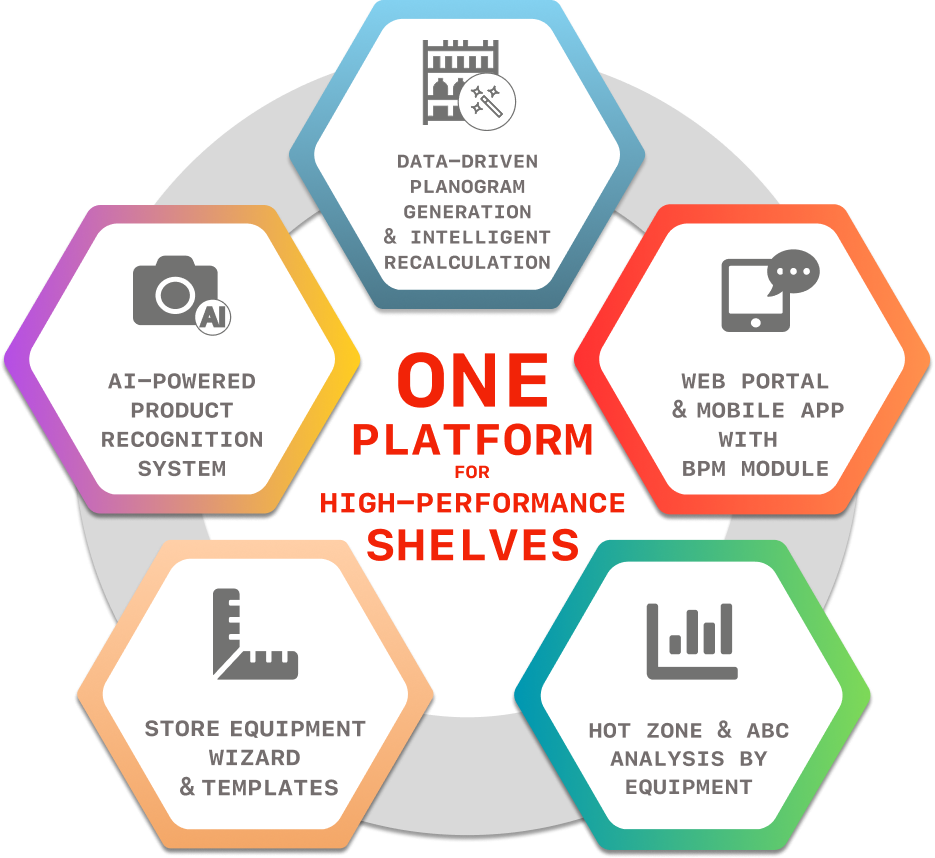
Retano Shelfplan is planogram software for category managers, planogrammers, and merchandisers in retail chains of any scale. It generates shelf layouts automatically based on sales data, ABC analysis, and predefined merchandising rules, placing the highest-performing SKUs in the best positions with the calculated number of facings.
Retano Shelfplan covers the full scope of retail space planning software: store format management, planogram templates by equipment group, bulk recalculation across stores when assortments change, and centralized approval and distribution to stores from a single interface.
Planogram Optimization in Practice
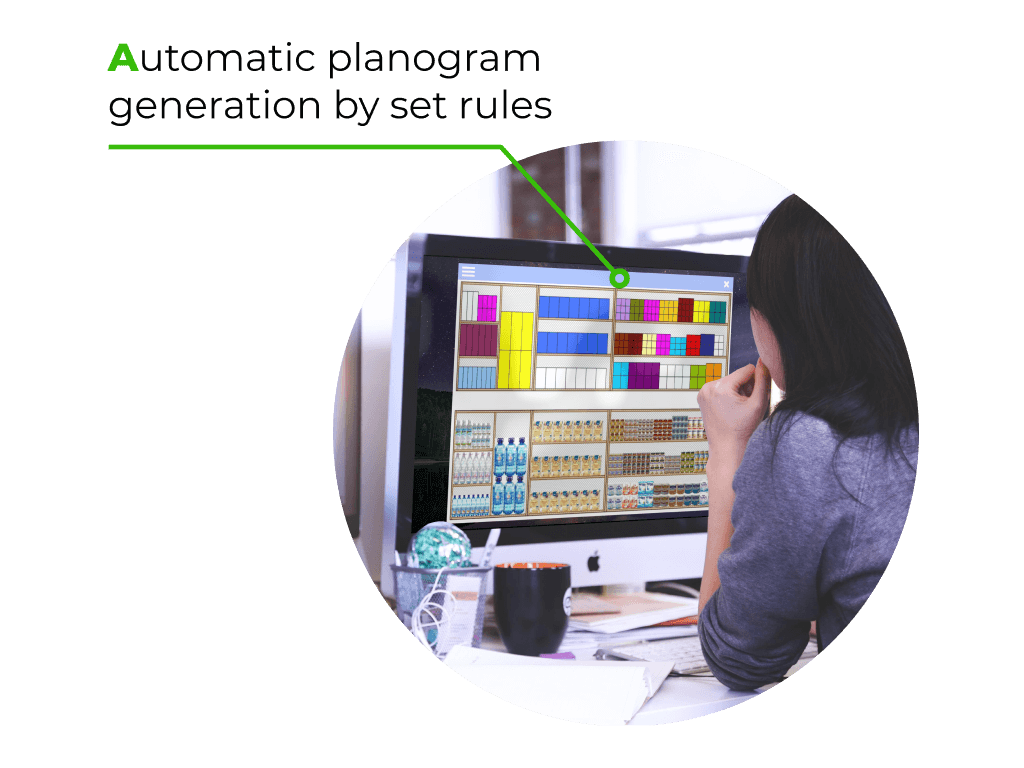
Retano Shelfplan generates planograms automatically based on predefined merchandising rules. The bulk recalculation job runs on a schedule, so routine updates complete without manual involvement, and layouts are distributed to stores automatically once approved.
When assortments change, the system recalculates affected planograms across all stores in the relevant format or equipment group, so a category manager does not update each store individually. Format-level layout rules and equipment group synchronization ensure that a change made once propagates to every store in the group automatically.
Retano Shelfplan supports both standard and promotional layouts. Planogram version control and change history give category teams a full audit trail, with the ability to compare any two versions side by side, see which SKUs were added, removed, or repositioned, and review the overall percentage of changes.
For new store launches, the system streamlines floor plan creation and ensures ongoing updates, keeping shelf space management aligned with real-time store operations.
Benefits
Reducing Head Office and Store Operations Costs
- Time saved on planogram release, updates, and feedback.
- Reduced time and effort required from Head Office staff in creating and updating planograms and shop floor plans for store equipment, product range, and display.
Improving Sales Performance and Shelf Space Optimization
- Standardized product displays across all stores in the chain.
- Strategic placement of high-margin products in “hot” areas for maximum profitability.
- The capability to display products on specific shelves based on thorough analysis of sales history, rather than solely relying on expert opinions.
- Grouping products based on display rules and cross-sales analysis.
- An optimal allocation of retail space based on sales history and market trends.
- Hot/cold area analysis per shelf/rack/store.
Features
Planogram Management
Retano Shelfplan gives category managers and planogrammers tools to manage shelf space at network scale:
- Automated planogram generation;
- Format-based planogram templates;
- Bulk recalculation when category assortments change;
- A change at the format level propagates to all stores in the group, without rebuilding each layout individually;
- Analysis of shop floor utilization efficiency, including by racks, item groups, and individual stores.
Store Execution
The system gives store staff access to current planograms and equipment layouts through a browser portal and a planogram mobile app.
Layout tasks are generated automatically when an approved planogram is exported to stores. Staff confirm execution with a photo report and communicate with the head office through a built-in chat.
Space Performance
Retano Shelfplan measures shelf space efficiency at rack, department, and store level, connecting sales data directly to the planogram so category teams can act on underperforming areas without leaving the system.
- Revenue per m² of retail and general area;
- Sales ratio vs effective shelf space;
- Hot/cold zone analysis with colour-coded equipment overlay;
- Display effective area and equipment utilization ratios;
- Shopfloor fill rate and equipment summary.
Compliance Control
Retano VeriShelf AI is an optional Shelfplan module that adds computer vision–based planogram compliance tracking. Audit tasks are generated automatically and delivered to store staff via the mobile app. Built-in ML models analyze shelf photos, recognize products, and detect layout deviations against the planogram. Store teams can:
- Photograph shelves and capture the realogram, the actual shelf state compared against the target planogram;
- Have audit results synced to the head office automatically;
- Receive corrective layout tasks automatically based on detected deviations.
See how Retano Shelfplan automates planogram management
FAQ
Why do retailers choose Retano Shelfplan for shelf management projects?
Retailers choose Retano Shelfplan because it automates planogram creation, links shelf decisions to sales and assortment data, and ensures consistent execution across stores, and in practice it is regarded as a reference platform in several Central Asian and European markets. The solution supports data-driven shelf management at any network scale, making it a consistent choice for long-term planogram management strategies.
What does Retano Shelfplan actually do for a retail chain?
Retano Shelfplan is used to create, maintain and update shelf layouts and planograms across a retail chain in line with the current assortment. The solution helps keep planograms up to date when products change, reduces manual work related to maintaining layouts, and provides a single working environment for merchandising and category teams to manage shelf space consistently across stores.
How does Retano Shelfplan approach shelf space optimization?
Retano Shelfplan focuses on managing planograms as part of an ongoing operational process. Layouts are updated when assortments change and are linked to real product structures, which helps retailers avoid outdated planograms and reduces the effort required to keep shelf layouts aligned with actual assortments.
How does planogram software handle planogram management across a large retail network?
Retano Shelfplan manages large networks through format-based equipment groups and scheduled bulk recalculation: when an assortment changes in a category, the system updates planograms across all stores in the relevant group automatically. A category manager overseeing multiple store formats updates the format-level template once, and the change propagates to every store in the group without individual edits.
How do shelf space management systems use sales and performance data to optimize space allocation?
In Retano Shelfplan, sales and performance data are used by the system to parameterize and drive shelf layout updates rather than being analyzed manually for each decision. Historical sales and availability indicators are applied as input metrics when recalculating planograms and adjusting space allocation rules.
Based on these parameters, the system updates shelf layouts in line with product performance and assortment structure, while keeping all calculations transparent and traceable. Category managers define rules and constraints, and Retano Shelfplan applies them consistently across layouts, ensuring that space allocation reflects actual performance data without turning planning into a manual process.
What level of automation can be realistically achieved in shelf space planning today?
With Retano Shelfplan, automation is applied to routine tasks such as updating planograms after assortment changes and consistently applying predefined rules. Strategic decisions, exceptions and final approval typically remain under manual control to ensure transparency and business alignment.
At the same time, in stable and well-structured categories, up to 100% of planograms can be generated automatically without the need for manual adjustments. In these cases, the system recalculates layouts based on defined parameters and constraints, allowing retailers to update shelves at scale while minimizing manual involvement.
This balanced approach reduces repetitive work and errors while preserving control over shelf planning decisions where it is required.
How do shelf space management systems integrate with category management, replenishment and ERP processes?
Retano Shelfplan connects with ERP and merchandising systems to use approved assortment and product data as the basis for shelf layouts, and returns shelf capacity, facing counts, and layout constraints back to support replenishment and category management decisions.
Assortment and product data from ERP and merchandising systems form the basis for shelf layouts, ensuring that planograms reflect approved assortments and store structures. In return, shelf space data generated in Retano Shelfplan, such as shelf capacity, facings and layout constraints, is used to support category management and replenishment decisions.
This cross-process interaction helps align assortment strategy, shelf capacity and ordering logic. As a result, category decisions are grounded in physical shelf constraints, replenishment processes better reflect real shelf availability, and changes in shelf layouts are consistently reflected across related planning and operational processes.
How does Retano Shelfplan manage planograms across different store formats?
Retano Shelfplan organises store equipment into format-based groups (hypermarket, supermarket, neighbourhood store, and others), each with its own planogram template and layout rules. When a template is updated or an assortment change triggers recalculation, the revised layout is applied to all stores in the group automatically. Category teams can maintain accurate, format-appropriate planograms across hundreds of stores without editing each one individually.
How do retailers control planogram execution and compliance in stores?
Retailers using Retano Shelfplan control planogram execution through a mobile application used by store staff to receive tasks and layout instructions. Store teams access approved planograms directly in the app, execute shelf changes, and confirm completion, providing head office with clear visibility into execution progress across the network.
Execution control is further enhanced by combining Retano Shelfplan with Verishelf AI, a computer vision solution that analyzes shelf images and compares the actual shelf with the target planogram. This makes it possible to automatically detect missing products, incorrect facings and layout deviations without relying solely on manual checks.
Together, mobile task execution and automated shelf recognition create a continuous feedback loop between planning and in-store reality, helping retailers maintain consistent shelf standards and quickly address execution issues.
How does Shelfplan build a planogram, and where does AI come in?
Retano Shelfplan calculates planograms from the category team’s merchandising rules and the chain’s sales data, so every layout can be traced back to its inputs. AI is used where images have to be read: the Retano VeriShelf AI module recognises products in shelf photos and compares the actual shelf with the approved planogram.
What happens when a new store opens?
A new store is assigned to an existing format group, so it takes that format’s planogram templates and layout rules instead of being planned from scratch. The team draws the floor plan and equipment layout in Shelfplan. From then on, the store receives the same bulk recalculations as the rest of its group whenever the assortment changes.
Publications

Umai Retail introduces new AI tools in Retano SCM for demand forecasting and replenishment
Umai Retail, the largest FMCG operator in Kyrgyzstan, is introducing new tools in Retano SCM: the Leonardo AI assistant, a control panel for demand forecasts, event and promotion planning, and local assortment management for stores. About Umai Retail Umai Retail is part of the Umai Group holding. It operates more than 170 stores under the… Read More »Umai Retail introduces new AI tools in Retano SCM for demand forecasting and replenishment
Category management software for retail chains: a 2026 buyer’s guide
The full process — from category role to measuring the effect of a change For a retailer with ten stores, assortment management is an analysis problem: one person looks at the numbers and decides. For a chain of 80, 200 or 500 stores it becomes an operational discipline that touches commercial strategy, supplier negotiation, replenishment… Read More »Category management software for retail chains: a 2026 buyer’s guide

Retano at NRF Retail’s Big Show Europe 2026
Retano Solutions took part in NRF Retail’s Big Show Europe, held on 15–17 September 2026 at Paris Expo Porte de Versailles, presenting its AI-driven retail platform at Stand C-070 in Hall 6. NRF Retail’s Big Show Europe is the European edition of the retail industry’s flagship event, co-organised by the National Retail Federation and Comexposium.… Read More »Retano at NRF Retail’s Big Show Europe 2026